
Edge Cases: The Long Tail Problem in Autonomous Driving

Executive Summary
- Autonomous vehicles excel in driving situations they encounter constantly, but real-world reliability and public trust are decided by the rare, unpredictable events sitting at the edge of the data distribution.
- Edge cases autonomous driving teams worry about most like unusual road layouts, erratic pedestrian behavior, poor weather, and complex multi-agent interactions are hard to collect, label, and evaluate precisely because they occur so infrequently.
- A dataset can look comprehensive on paper while still hiding critical gaps in geography, conditions, behavior, and scene complexity.
- Scaling data volume alone does not solve the long tail problem autonomous vehicles face. What's needed is a systematic way to find rare scenarios, prioritize them by risk, and capture enough context to actually learn from them.
- For business leaders, unresolved long-tail gaps translate directly into deployment delays, liability exposure, and slower regulatory approval making this as much a business risk as an engineering one.
- Long tail coverage isn't a one-time dataset problem to solve but an ongoing capability, built by connecting real-world model failures back to targeted collection and annotation work.
When 99% Accuracy Doesn’t Make The Cut
Every AV brand can point to a fleet built on strong numbers. Millions of miles driven, high accuracy score, clean safety reports can look tempting to potential customers at first. However, the moments that decide whether a self-driving program earns trust from the public and regulators are the ones those averages rarely capture.
This is how the long tail problem in autonomous vehicles comes into play. To understand the long tail problem, a popular concept from statistics, imagine plotting every driving scenario a vehicle might encounter by how often it occurs.
The shape starts off tall on one end based on the handful of things that happen constantly, like lane-keeping or stopping at a red light. Eventually, it gradually flattens into a long, thin strip stretching out into thousands of individually rare events such as sudden shift in weather, a motorist balancing a microwave on his shoulders, or even two wild animals fighting in the middle of the road.
While each of these is uncommon on its own, together they carry a disproportionate share of real-world risk, precisely because a system rarely has enough repetition to learn from them. For engineering teams, that's a modeling challenge.
For the business behind the program, it's a brand, safety, and regulatory risk sitting just outside the data most dashboards report on and understanding it matters for anyone building, funding, or bringing an autonomous driving product to market.
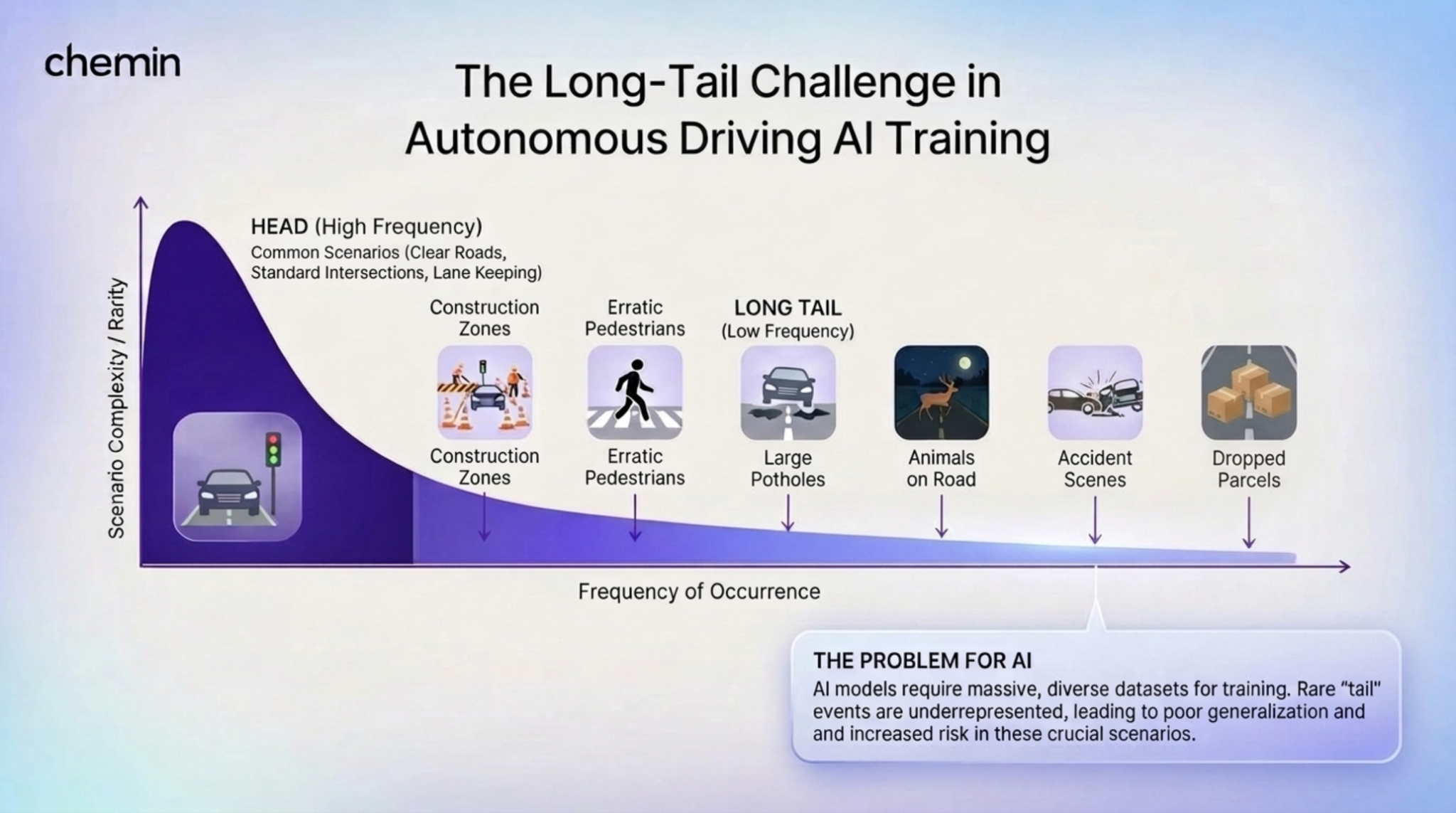
Fig 1: Illustration of Long Tail Problem in Autonomous Driving in AI Training
The Tail Strikes Back
Most leading AV systems now handle ordinary driving well, which is exactly why competitive and regulatory pressure has moved almost entirely to the tail. This is how a system behaves in situations it has rarely, or never, seen. Regulators increasingly judge AV programs on rare-scenario handling rather than aggregate mileage. Similarly, public trust also follows the same pattern. A handful of high-profile failures in unusual scenarios can set back an entire brand’s rollout, regardless of how well the system performs on ordinary roads. A system can be 99% accurate overall and still fail on the 1% that matters most, which is where AV model performance edge cases diverge sharply from average metrics.
There are three things that make long-tail data which autonomous vehicles rely on especially hard to work with. For one, they are rare by definition, so doubling total data barely improves coverage of an event occurring once every few million miles. The second is that the data often combines several sources of uncertainty at once and this is where object behavior labelling gets difficult, since individually ordinary elements can combine into real danger. The third is that coverage gaps hide behind aggregate numbers. So a dataset can look comprehensive while quietly failing in a narrow, safety-critical slice that average metrics never surface.
What the Data and Experts Agree On
Research analyzing large driving datasets consistently finds a handful of common classes such as cars, pedestrians, ordinary traffic, dominating the data, while genuinely unanticipated objects appear in only a fraction of frames, if at all. A SearchAD benchmark, which pooled 423,798 frames from 11 established driving datasets, found that its 30 rarest categories each showed up in fewer than 250 frames while some in fewer than 50.
Any edge case taxonomy for AV driving should be separated into two kinds of rarity which are rare objects (an uncommon obstacle) and rare scenarios (ordinary objects arranged unusually, like a cyclist carrying an oversized load).
The second is harder to catch, since nothing about the individual objects looks unusual alone and it's also why brute-force collection plateaus. Ordinary footage is cheap to gather while rare scenarios are not, and past a point, more routine data mostly reinforces what a model already handles well.
In an article by Techbrew, industry leaders increasingly frame this as a reasoning problem rather than a coverage problem. May Mobility CEO Edwin Olson has compared exhaustive edge-case collection to "the game of Pokémon" the assumption that cataloging every rare event will prepare a system for anything. He argues this struggles because new situations keep appearing no matter how much has been collected, while even a novice human driver can often reason through something they've never seen before.

Fig 2: Edwin Olson, CEO of May Mobility, a US based AV company specialising in self-driving shuttle and robotaxi service
Similarly, Motional CEO Laura Major pointed out that less than 1% of the driving data Motional’s fleet collects is helpful, which prompted their Omnitag data mining system. Meanwhile, S&P Global Mobility's Jeremy Carlson, who leads autonomous driving research at the firm, frames edge cases similarly where unusual situations a system must still manage safely because they sit outside routine driving. Both point to the same shift from rigid, rules-based systems toward more adaptive, reasoning-capable AI.
What This Means For The Business
Unresolved edge cases can define an AV launch. A smooth rollout fills showrooms but one freak accident could trigger a PR nightmare that erodes years of public trust. The fallout doesn't stop there. Regulators are also forced to respond by scrutinizing how the system handles rare and risky scenarios specifically. This can drastically slow down deployment timelines, proving how a single failure in an untested scenario can carry significant legal and financial ramifications. Even if most AV systems excel at everyday driving, it's these rare and unexpected scenarios that are becoming the main way companies stand apart on safety.
Fortunately, the technical teams that manage the long tail AV systems well tend to work through five connected stages:
- Discovery: corner case detection self-driving cars systems can run continuously (anomaly detection, sensor disagreement, confidence drops), flagging rare scenarios automatically within the autonomous vehicle data pipeline.
- Scenario definition: a shared edge case taxonomy autonomous driving teams use across data, safety, and engineering, capturing why a scenario was rare so similar cases can be grouped.
- Annotation: going beyond routine data annotation for autonomous driving with object behavior labelling and multi-sensor data labelling AV systems depend on, since camera, LiDAR, and radar each capture a different piece of what made a moment risky, the core of rigorous sensor data annotation in autonomous driving.
- Validation and simulation: using edge case simulation autonomous vehicles teams rely on to stress-test dangerous combinations that can't be waited for on real roads, strengthening autonomous vehicle safety validation.
- Continuous evaluation: treating edge case dataset curation as an ongoing cycle, routing field failures back into annotation so AV training data quality improves alongside deployment.

Fig 3: An idealised workflow for data annotation teams to collect and train AVs for edge detection cases
Across all five, risk-based scenario prioritization aligned to a program's specific operational design domain (ODD) coverage keeps effort focused on the rare scenarios most relevant to how the vehicle actually operates.
Playing The Long Game
The long tail doesn't get solved once. It is a moving target that grows as vehicles reach new regions and conditions. Rather than one-off data pushes, technical teams need repeatable processes for managing the long-tail. Meanwhile, business leaders need to see long-tail investment that’s tied directly to deployment speed, liability, and the trust an AV program depends on to scale.
Let's Talk About Your Data Pipeline
Discover more

GPT-4o-mini vs SEA-LIONv3: Bahasa Indonesia LLM Evaluation
A 50-task study tested Indonesian-specific prompts in English and Bahasa Indonesia to examine how model preferences varied across local-context tasks.

What Is Data Labeling? A Comprehensive Guide
Without properly labeled data, ML models struggle to understand key features, leading to unreliable results. This guide explores what data labeling is, how it works, different approaches, best practices, and its real-world applications.

SEA-LIONv3 vs SahabatAI-v1: Bahasa Indonesia LLM Evaluation
SEA-LIONv3 and SahabatAI-v1 were tested on 50 Indonesian-specific tasks to examine how model preferences changed across task categories and prompt languages.