
How the Team Built a Humanoid Robot Teleoperation and Annotation Team for Humanoid Warehouse Robots
98%
Operator task accuracy, against a 98% target
2x
Sorting speed target (30 vs 15 items/min)
3 Weeks
to build a robot video annotation workflow from scratch
30%
less annotation handling time per video minute, in testing

USE CASE
Teleoperation | Data Annotation | Pre-Annotation

INDUSTRY
Robotics

SOLUTION
Data Operations Infrastructure

TLDR
- A humanoid robotics company needed remote operators to sort and kit items in US warehouses and label robot footage for model training. It had a tight budget and no existing annotation setup.
- The team launched a humanoid robot teleoperation programme 10 weeks after kickoff, then expanded from one shift to two across two warehouse sites. Operators maintained 98% accuracy and reached 30 items per minute in sorting, twice the 15-item target.
- The team built a robot video data annotation workflow from scratch in three weeks. Across three test rounds, handling time fell from 2.5 hours to 1 hour 45 minutes per minute of video.
- The team began developing a pre-annotation tool that drafted bounding boxes for human review. Early tests identified the correct item in all eight test cases.
- The project showed why robotics teams need to agree on label structure, input formats, and escalation procedures before work even begins.
The Problem
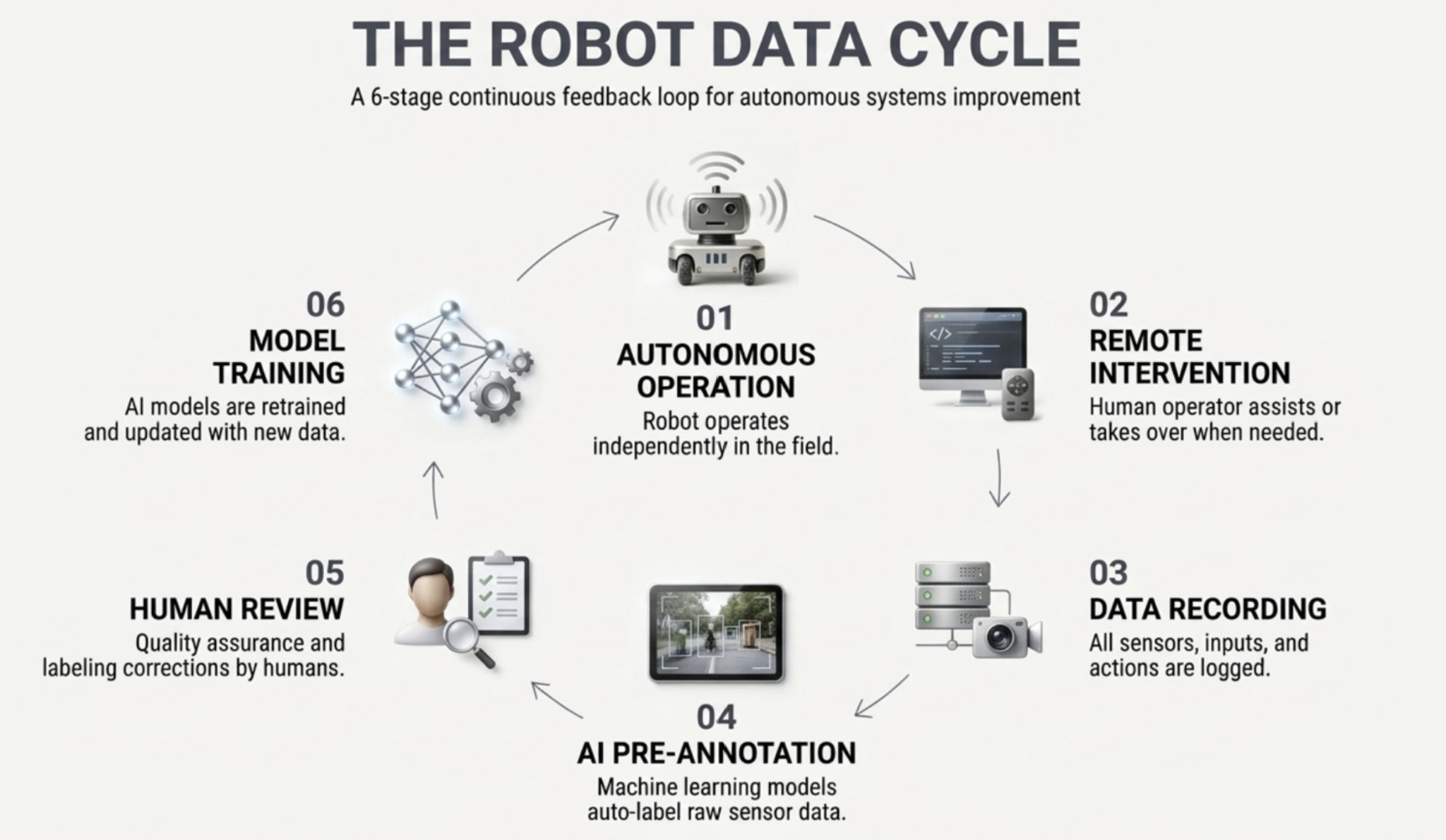
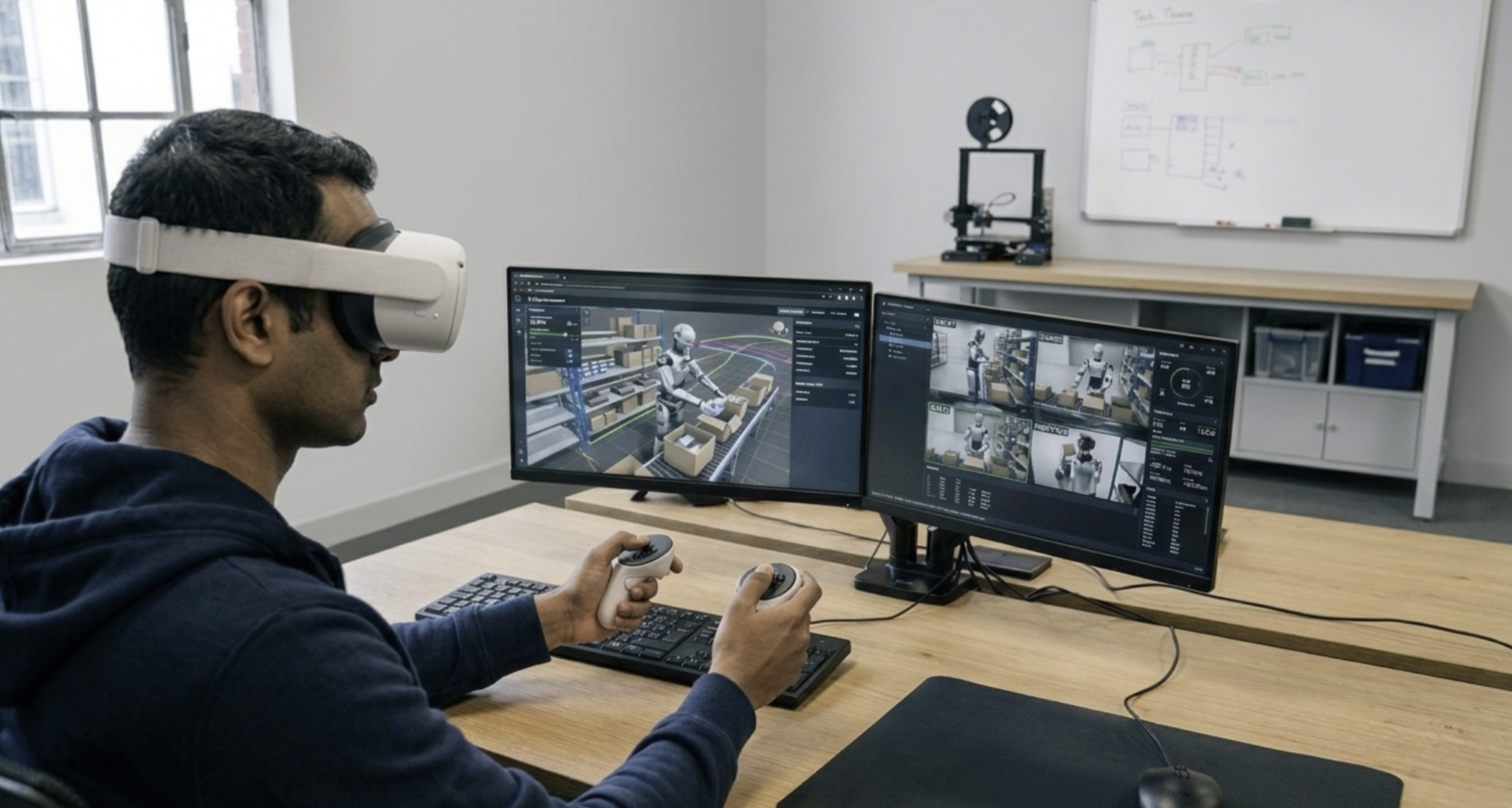
Humanoid robots in warehouses still needed human intervention. When a robot's autonomous system could not complete a task, a remote operator took control, finished the task, and recorded a demonstration that could be used as robot demonstration data to train the robot.
The client deployed humanoid robots for sorting and kitting in US warehouses. It needed a dedicated team of remote operators covering US Central business hours, from 8 a.m. to 5 p.m., five days a week.
Each operator had to meet strict performance targets: 98% task accuracy, 15 items per minute for sorting, and six items per minute for kitting.
The client also needed its robot footage converted into training data. It had no established annotation workflow and a limited budget, so it needed a partner that could quickly establish the tooling, process, and pricing.
The Challenge
Five main challenges shaped the project:
- No established training process. The initial training materials consisted of a one-page module and a 15-minute briefing. Because operators used different techniques to control the robots through virtual reality (VR), there was no single standard method to teach.
- Physical and technical constraints. VR teleoperation caused shoulder soreness and eye strain during the first week. Network latency affected operator speed and accuracy. Hardware failures sometimes took robots offline for hours, and without backup robots on site, work stopped until engineers completed repairs.
- A last-minute change in scope. The team had trained for kitting, but the client switched the task to sorting with one day's notice before go-live.
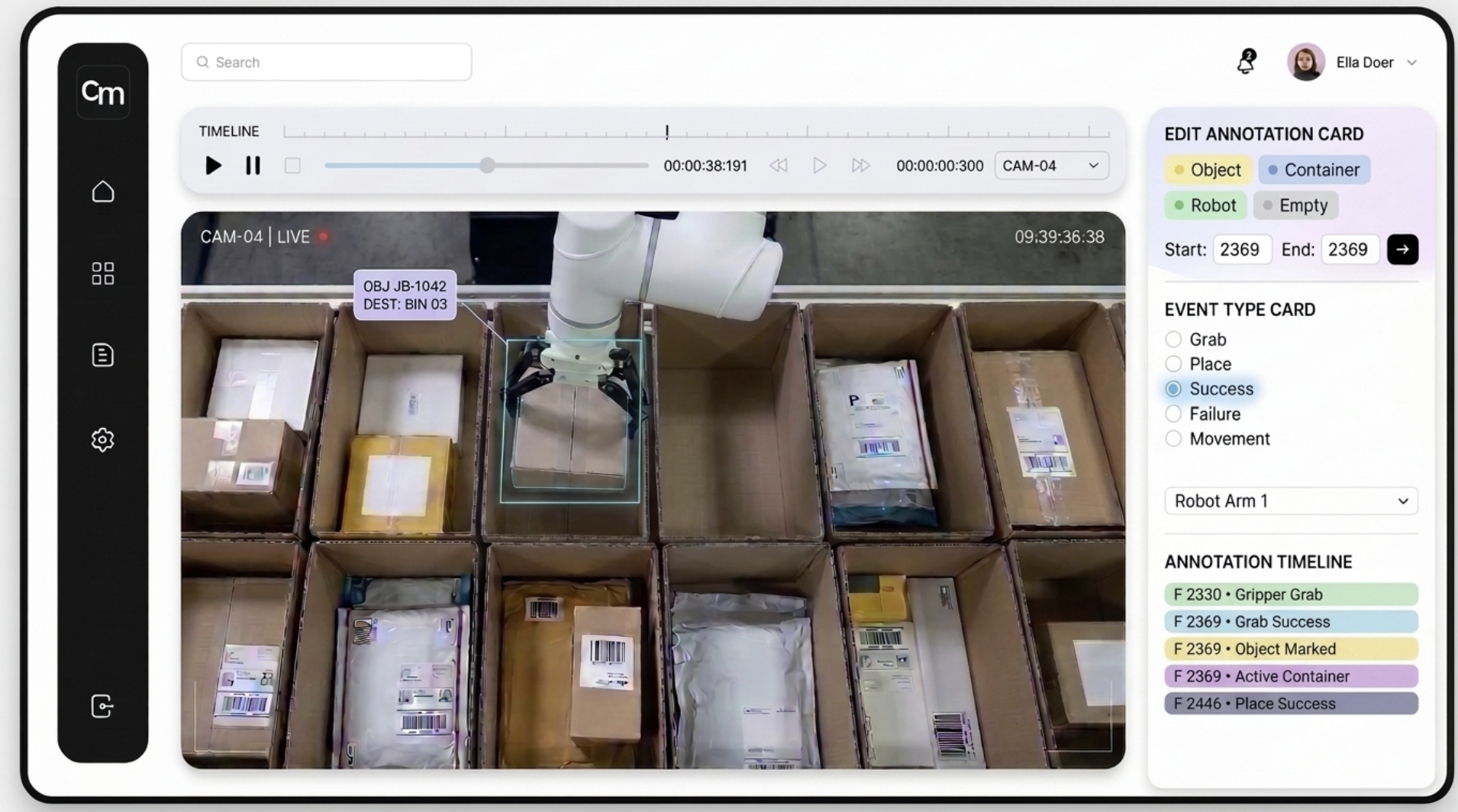
- Complex footage and annotation requirements. Both robot arms moved in the same camera view, so annotators had to label each arm's actions separately. Recordings arrived as raw robot log files with varying frame rates, and labels had to match the exact timing of each action. Failed or unclear grabs also needed consistent labels. Delayed or inaccurate annotations risked holding up model training.
- Hard to Label Footage. Two robot arms moved at once in the same camera view, so each arm's actions had to be labelled separately. Recordings arrived as raw robot log files with varying frame rates, and every label had to match the exact moment of the action. Some grabs failed or were unclear, but still needed a consistent label. Late or inaccurate labels would delay the client's model training.
The Approach
The team managed the project through the following two specialist groups:
- Teleoperation: The team recruited and trained remote operators, managed shift performance, and established escalation procedures through team leads. This included setting up humanoid teleoperation workflows with the client’s engineers.
- Data annotation: The team built the video data annotation workflow, selected the tooling, established pricing, and began developing pre-annotation capabilities to reduce manual work.
For teleoperation, the team worked with the client's engineers to set up a practice area on the warehouse floor. Operators developed their own control techniques while working toward fixed accuracy and speed targets.
For annotation, the team proposed organising labels by robot arm rather than treating the footage as a single sequence of timestamped events. This made each grab-and-place sequence easier to follow, from the initial grab through successful placement or failure. The client adopted this structure.
The Execution
1. The team launched the operator programme in 10 weeks
The project ran from kickoff to a live operator team in 10 weeks, including a 30-day training and nesting period. Four of the six trainees qualified as operators.
2. The team introduced gradual rotations to manage VR teleoperation fatigue
The team set shorter, more frequent breaks for VR teleoperation so they could recover between rotations and maintain their speed and accuracy through a full shift.
Operators started with one-hour rotations in the first week. As they built stamina, rotations increased to two hours and then four hours.
3. The team adapted to a last-minute task change
When the client switched from kitting to sorting, operators moved to the new task the following day without additional retraining.
4. The team established clear escalation procedures
Operators handled routine issues such as calibration, repositioning, and reboots, usually within one to two minutes. Hardware faults went through the team lead to the client's on-site engineers, while network issues were escalated to on-site IT.
5. The team logged every task outcome
Operators recorded each task as successful, unsuccessful, a jam, or stacked items. These records gave the client a consistent view of operator activity and robot performance.
6. The team built the annotation workflow in three weeks
The team evaluated five annotation platforms, converted raw robot logs into constant-frame-rate video, designed the workflow and pricing, and delivered files in the client's required format. A platform partner customized its tool to meet the project's requirements.
7. The team built the video data annotation workflow in three weeks
Every clip went through two review passes. Automated checks also validated the output format against the project's 95% accuracy target.
8. The team began developing a pre-annotation tool
Bounding box annotation accounted for a significant share of the original annotation work. To reduce that effort, the team began developing a tool that drafted boxes around the gripper, item, tray, and destination box for each robot arm.
The process started with people marking each grab and placement. The tool then drafted bounding boxes within those moments, which annotators reviewed and corrected.
The tool combined an off-the-shelf vision model with rules based on robot movement. It also ran on the team's own hardware, keeping the client's footage private.
The Results
The operator team met or exceeded the client's performance targets.
- Task accuracy reached 98.26%. Daily measurements from the client's fleet dashboard showed that operators met the 98% target.
- Sorting speed doubled the target. Operators processed 30 items per minute against a target of 15. Kitting reached 6.5 items per minute against a target of six.
- Coverage expanded. The operation grew from one shift at one warehouse to two shifts across two warehouse sites.
- Operator attrition remained at 0%. No operators left the team after go-live.
- Annotation handling time fell by 30%. Across three rounds of testing, processing time decreased from 2.5 hours to 1 hour 45 minutes per minute of video covering both arms.
- Pre-annotation improved early test results. The tool selected the correct item in eight out of eight test cases, compared with four out of eight before a new selection rule was added. A separate frame-timing fix improved gripper accuracy by approximately 70% from a low baseline.
Maintaining accuracy while operating at twice the target sorting speed gave the client greater throughput while preserving the quality of its recorded demonstrations.
The Metrics
All figures come from project data verified by our operations team.
Metric | Target or baseline | Result | Period |
Operator task accuracy | 98% target | 98.26% | May 2026 |
Kitting speed | 6 items/min target | 6.5 items/min | May 2026 |
Teleoperation hours delivered | 111.25 hrs | 704 hrs | July 2026 |
Kickoff to live operator team | - | 10 weeks | Mar to May 2026 |
Trainee qualification rate | - | 4 of 6 | Apr to May 2026 |
Operator attrition after go-live | > 25.76% | 0% | May 2026 onward |
Annotation workflow build time | 1–5 weeks | 3 weeks | Mar to Apr 2026 |
Annotation handling time per video minute (both arms) | 2.5 hrs baseline | 1 hr 45 min | Three test rounds, Mar to Sep 2026 |
Pre-annotation: correct item selected | 4 of 8 | 8 of 8 | Sep 2026, one video, early result |
Pre-annotation compute per 10-minute video | n/a | Under 2 GPU hours | Sep 2026 |
Lessons Learned
- Build the training environment before go-live. A short training guide cannot teach everyone the same way on how to operate a robot. By setting up a practice area on the actual warehouse floor, and set up with the client’s engineers, this gives operators a chance to learn by doing.
- Account for physical fatigue. Prolonged VR teleoperation sessions puts physical stress and strain on operators. Start with short rotations and gradually increase them as operators build stamina helps to reduce fatigue while maintaining accuracy.
- Define escalation procedures early. Teams need to decide which problems operators can fix themselves and which require engineering support. When a robot breaks downs, operators need to know exactly who to contact to get it running again.
- Prepare for changes in scope. Clients may change tasks shortly before go-live. Operators who understand the robot’s controls can adapt more easily when priorities change, even on a short notice.
- Agree on label structure and file formats before annotation starts. Organizing labels by robot arm makes each grab-and-place sequence easier to follow. Agreeing on these details early helps prevent reworks and wasted time.
- Use robot behaviour to improve object selection. The vision model initially returned 70 to 90 possible items per frame but sometimes missed the correct one. Teams can improve the results by adding a simple rule: select the moving item closest to the robot’s gripper.
- Check frame timing before tuning the model. Two missing sections in a video’s timeline caused the later frames to fall out of sync. Matching frames by timestamp produces the biggest improvement in gripper accuracy during testing.
Expert Insight
Every task a remote operator completes provides the robot with an example of how to perform said task. If the operator makes a mistake, that error becomes part of the robot’s training data. This makes accurate task execution and precise video annotation essential to building reliable training datasets. Evaluating teleoperation and annotation separately can leave robotics teams with operators who work quickly but produce inconsistent training data.
Frequently Asked Questions
How long did it take to set up the remote teleoperation team?

The team went from kickoff to go-live in 10 weeks. That period included recruitment, workstation setup, and a 30-day training and nesting period. The timeline depended on the training materials and practice access the robotics company could provide.
Could remote operators control robots across time zones?
Yes, they could. The operators worked remotely during US Central business hours, using VR headsets and handheld controllers. Network latency remained a key constraint, so connectivity checks and escalation procedures with on-site IT were established as part of the operating model.
What happened when a robot failed during a shift?
Operators handled routine issues such as calibration, repositioning, and reboots, usually within one to two minutes. Hardware faults were escalated through the team lead to the robotics company's on-site engineers. Defining these escalation tiers helped limit avoidable downtime.
What did the pre-annotation tool do?
The tool drafted labels before annotators reviewed a clip. People first marked when each grab and placement occurred. The tool then drew boxes around the key objects during those moments, and annotators corrected the results. This reduced the amount of manual drawing required when a draft box needed only a small adjustment.
How can robotics companies scale humanoid robot teleoperation?
A robotics company can start with a trained remote operator team, clear task targets, a practice environment and escalation procedures for technical issues. In this case study, the team launched in 10 weeks and expanded to two shifts across two warehouse sites. Request a pilot to discuss an operating model for your robot fleet.
Can teleoperation and robot data annotation be managed together?
Yes. In this case study, remote operators completed warehouse tasks while a separate team built an annotation workflow for robot footage. The workflow was ready in three weeks, and testing reduced annotation handling time by 30%. If you need both robot operations and training data support, request a pilot to scope the work together.
Planning a remote operator programme, or need robot footage labeled at production speed?
Request a pilot and we'll scope teleoperation and annotation together for your robots.
More stories
Turning mission-critical data into waste intelligence
Accelerated waste recognition AI by delivering 1 million high-accuracy, compliance-ready annotations monthly through expert-driven workflows and rapid data turnaround.

Audio AI Annotation for a Premier Gaming Studio: Scaled Output by 294%
Prepared 629.5 hours of conversational audio in 30 days while maintaining 99% accuracy and zero rework.
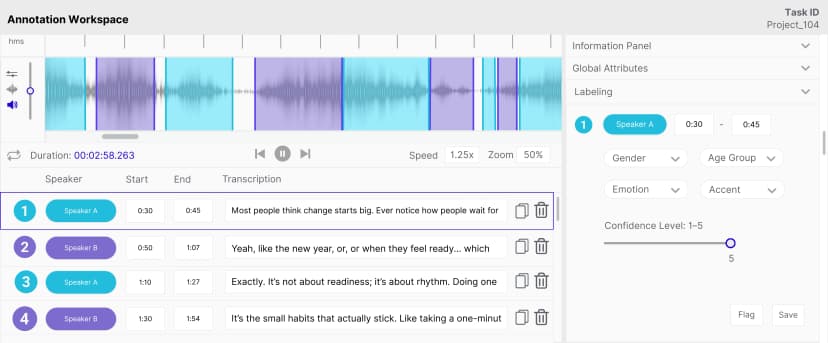
Gaming Audio Annotation: Structuring Speech Cues at 95%+ Accuracy
Turned emotion, accent, demographic, and speech cues into structured training data for adaptive game AI.