
Teleoperation vs Egocentric Video: Which Data Creates Better Robot Policies?
Key Takeaways
- Robots with execution problems need targeted teleoperation data to improve grasping, movement, and task accuracy.
- Robots that struggle with unfamiliar objects or environments need broader exposure through egocentric video.
- Growing robotics systems need diverse demonstrations that cover more tasks, objects, and operating conditions.
- Deployed robots need a feedback loop between failure analysis, targeted data collection, retraining, and evaluation.
- Combining teleoperation and egocentric video can address different learning needs, but more data or mixed modalities do not guarantee better results.
- The competitive advantage comes from identifying the robot’s current bottleneck and building a data pipeline that addresses it quickly.
Understanding The Task
Imagine you’re training a hospitality robot to serve drinks in a hotel. In the training room, the robot pours the English tea perfectly every single time. Exactly 225 milliliters, not a drop more or less. One day, someone moves the cup or switches the drink to coffee instead, which has an entirely different consistency. Your robot now has two possible problems: it may struggle to execute the pour accurately, or it may struggle to adapt when the task changes. The next step is to identify which failure matters most and collect data that addresses it.
Teleoperation data for robot learning (or teleops) comes from a human guiding a robot while the system records observations and control commands. It provides direct examples of how the robot should execute a task.More recently, egocentric video data collection just involves a person wearing a camera and doing the task manually with no need for expensive hardware. This makes it possible to collect examples across a wider range of objects, environments, and conditions.
However, choosing between these modalities based on cost or superiority misses the real question: what does the robot need to learn next?
owever, choosing between these modalities based on cost or superiority misses the real question: what does the robot need to learn next?
Matching Teleops or Egocentric Video
People love competitions and comparisons. It’s in our nature. However, teleoperation vs egocentric video data is less about picking a winner and more about identifying the problem each source can help solve. Teleoperation records the robot's observations and control commands, making it useful when a policy needs better examples of what to do. Egocentric video captures human actions across varied situations, offering a way to expand exposure to objects, environments, task variations, and intent.
Neither source automatically produces a better policy, and collecting both does not guarantee better results. In HumanEgo’s co-training experiment, every tested mixture performed below human-only training. The result makes the training recipe a variable to test instead. The practical question is which source addresses the robot's current failure, and whether the resulting data improves performance when evaluated.
Precise but Expensive
In a previous article, we covered how autonomous robot teleoperation system works by having a human directly control a robot, often with joysticks, wearable gloves, VR-style controllers, while the system logs both what the robot's camera sees and the exact command issued in that same instant. That paired record is the whole value proposition: nothing is inferred, nothing is estimated. This is what makes human-in-the-loop imitation learning using remote teleoperation so reliable at the level of raw execution since every action is captured directly and nothing is left to assumption.
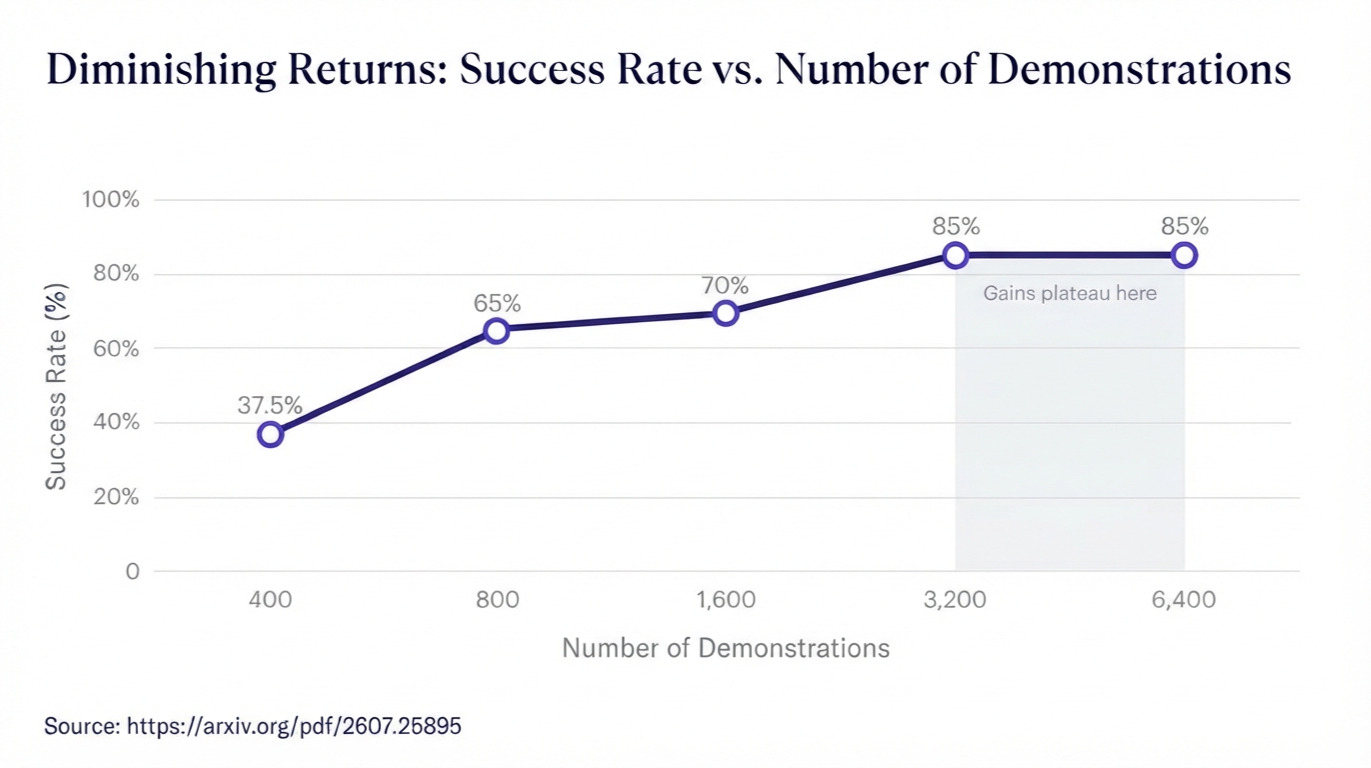
It's also exactly why teleoperation doesn't scale the way people want it to. Every demonstration needs a physical robot and a trained pilot, in real time. A study presented at ICLR 2025, using more than 40,000 demonstrations and 15,000 real-world robot rollouts, found that diversity of objects and environments mattered more than demonstration count alone. Additional examples within the same conditions eventually brought limited gains. For teams collecting robotics training data, this makes the failure pattern important: if a robot already knows the task but struggles with unfamiliar objects or settings, more repetitions under identical conditions may not address the gap.
Affordable but Mixed Results
Then we have egocentric video for robotics which oddly enough, skips the robot entirely. A person wears a camera on their head and just does the task. Whether it’s folding laundry, pouring a cup of tea, assembling Lego, all recorded footage becomes the training signal. Egocentric data for robots is cheap because it scales with people. Instead of a trained pilot and expensive robot, anyone can be a contributor with next to zero hardware, and surprisingly, the results have gotten hard to dismiss. A separate HumanEgo study on robot learning from human egocentric videos found an egocentric-trained policy that beat a matched-time teleoperation baseline by 41%, with human demonstrations taking roughly half the time to collect as teleoperated ones on the same hardware. Meanwhile, another separate research adding a wrist-mounted egocentric view found dexterous, contact-rich tasks like USB insertion hit 90%+ success rates, against 50-60% for third-person-only baselines.
None of that comes free. A human hand doesn't move like a robotic gripper so this creates the "embodiment gap". A robot learning from human demonstrations collected this way needs a real translation step before it's usable. Skip that step, and the results are bad: one study found zero-shot deployment of raw human video, with no robot-specific adaptation, produced 0% success across every task tested. You might think egocentric video is the best shortcut to robot training only to find yourself swarmed with tons of translation work later down the line. Its value depends on whether the additional human demonstrations address a real coverage gap and whether the resulting data can be translated into useful training signals for the robot.
Head to Head
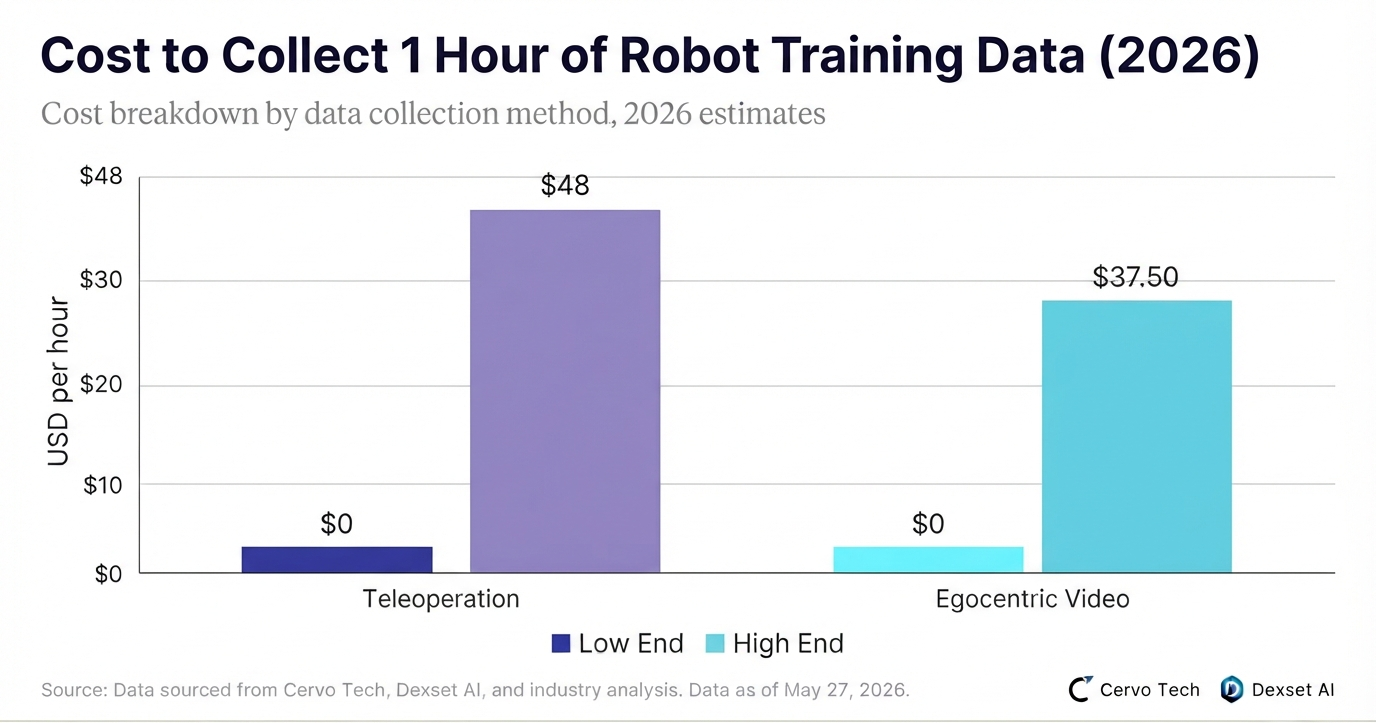
If you were to pit both modalities against each other, cost and scale favor egocentric video since it doesn't need robot hardware or a trained pilot, just a (moderately tech savvy) grandma and her iPhone. On the other hand, teleoperation offers a more direct record of robot-specific actions, making it useful for improving execution.
But these advantages matter only in relation to the problem being solved. If the robot consistently misses grasps or places objects imprecisely, more demonstrations on the target hardware may be the better next step. If it succeeds in familiar conditions but fails with unseen objects, lighting, or workspace layouts, broader egocentric video collection may offer more value.
The goal isn't to maximize one type of data or blend everything by default. It's to identify the failure, choose the data source most likely to address it, and measure whether performance improves.
Teleoperation Targets Execution Errors
Here's the sharper way to think about what teleoperation produces: direct examples of how a robot should execute a task. A human operator guides the robot through a command sequence, and the system records the observations and actions. When the policy struggles with missed grasps, slips, or imprecise placement, these demonstrations provide concrete examples of the desired behavior.
However, more teleoperation data isn't automatically the answer to every failure. In our earlier example, a robot can be trained to pour tea accurately under familiar conditions. But if the liquid changes to coffee or the cup moves, the robot might pour too much or too little. If the problem is adapting to unfamiliar conditions rather than executing a known action, repeating the same demonstration may do little to close the gap.
Egocentric Video Expands Exposure
The value of egocentric video data for robot learning goes beyond its lower collection cost. It gives teams a way to expose models to more objects, environments, and variations without requiring a robot and trained operator for every demonstration. This can be useful when a policy performs well in familiar conditions but struggles to adapt to changes.
Research on learning from human video also suggests that these demonstrations can help models learn useful information about task intent and context. A recent paper from Tsinghua University on learning human-intention priors found that modeling the intent behind a demonstration improved motion plausibility and spatial grounding, beyond raw task success. Meanwhile, LIME offers a concrete example: it uses egocentric video to train models to choose camera viewpoints in response to language instructions. This shows how human footage can support learning where to look next.
The key question is whether this broader exposure helps the robot handle situations it previously failed. Egocentric video may expand what a policy encounters during training, but it doesn't automatically translate into better execution on the robot.
One caveat remains: information in raw footage doesn't transfer automatically. Someone still needs to extract useful details, such as where to grip an object and the path a hand follows. Robotics data annotation for machine learning and an appropriate translation pipeline help turn human footage into training signals a robot can use.
Building Policies, Not Programs
This is the distinction the whole debate keeps missing. A program executes fixed instructions and stops working when the world doesn't match its expectations. A policy is supposed to generalize, allowing a machine to make decisions when a situation differs from what it saw in training. That's the premise of robot imitation learning: not merely following a path, but learning a reusable way to act.
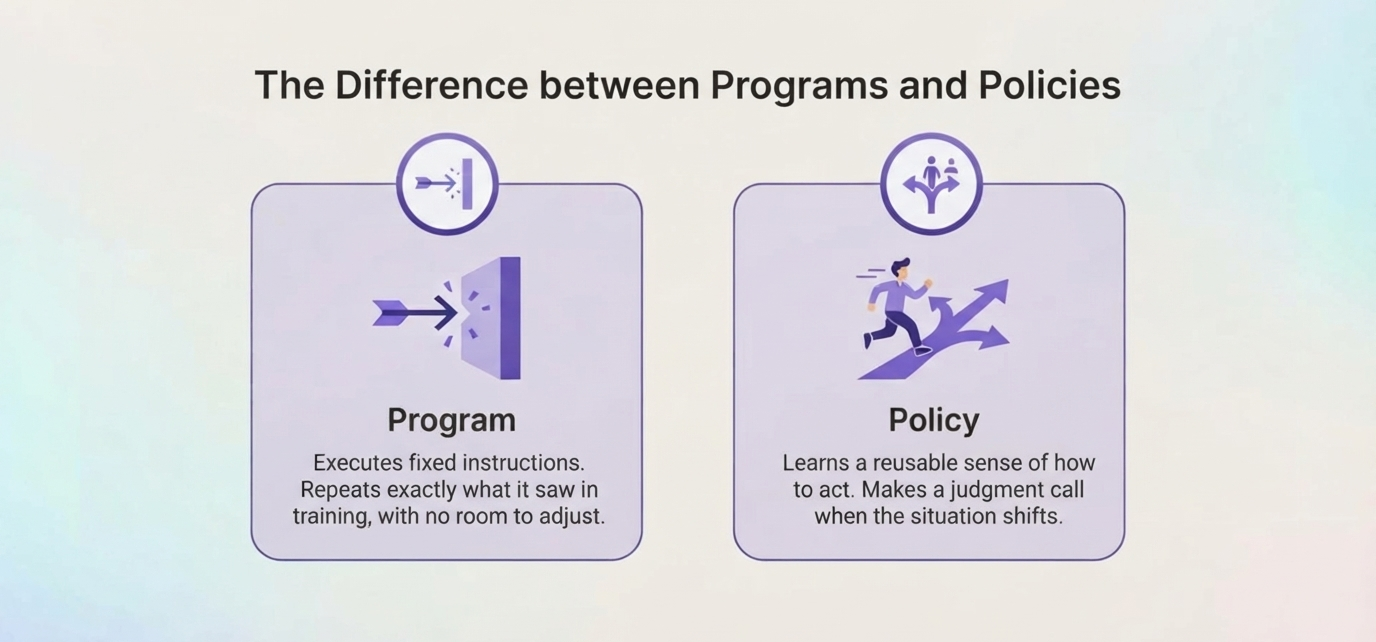
Neither teleoperation nor egocentric video guarantees that kind of generalization on its own. Teleoperation can help a policy improve how it executes actions on the target hardware, while egocentric video can broaden its exposure to task variations and environmental conditions. These approaches also intersect with diffusion policy robotics imitation learning, where policies learn robot actions from demonstrations. The right choice depends on where the policy fails, while evaluation determines whether the new data actually helps. That's particularly important for language-conditioned imitation learning for robot manipulation, where a single policy must follow varied instructions across many tasks it was never explicitly shown.
How We Decide Which Data to Collect
The choice between teleoperation vs egocentric video data starts with one question: what is your robot struggling with right now?
If it struggles with execution, such as missed grasps, slips, or imprecise placement, it needs more examples of the action performed on its own hardware. Enterprise robotics teleoperation programs fit here. A trained operator demonstrates the task on the target robot, and the recorded controls give the policy direct examples to learn from. Operators can still make mistakes and the policy still needs testing, so we treat this data as a way to reduce execution errors and measure what remains.
If it struggles when conditions change, such as an unfamiliar object, new lighting, or a different workspace layout, it needs wider exposure. Egocentric video data collection fits here. Contributors perform the task across many real settings, which gives the policy a broader range of situations to learn from. Wider exposure improves the odds of handling change, and the footage still needs careful annotation before a policy can use it.
Then we test whether the data helped. We work with your team to set aside an evaluation set before collection begins: grasp-heavy tasks to measure execution, and unseen objects and settings to measure adaptation. After each collection round, we run the same set again. If grasp success rises while performance in unfamiliar settings stays flat, the next round leans toward broader collection. If adaptation improves but grasps still fail, it leans back toward teleoperation. If a data source moves neither number, we revise the brief before collecting more.
Good robot policies adopt multiple forms of human demonstration. We build ours by matching each source to what the robot needs, and the evaluation results decide what we collect next.
Frequently Asked Questions
Is egocentric video actually better than teleoperation?

Neither is universally better. Teleoperation is useful when a robot needs more precise execution examples, while egocentric video can expand exposure to unfamiliar objects and environments. The right choice depends on the failure you're trying to address and whether evaluation shows an improvement.
Can egocentric video replace teleoperation entirely?
Not entirely. Some research systems learn specific tasks without requiring robot demonstrations. Whether that approach suits your deployment depends on the task and the transfer method.
Why not just collect more teleoperation data instead?
Because the returns run out. The data shows performance scaling logarithmically with demonstration count. You can't buy your way past a modality problem with more robot hours without running into some serious diminishing returns.
What does "matching, not blending" actually mean in practice?
It means choosing data based on the robot's current limitations. If grasping or placement is unreliable, test whether teleoperation improves execution. If performance drops with unfamiliar objects or settings, test whether broader egocentric video collection improves adaptation. Evaluate the results before deciding what to collect next, rather than mixing data sources by default.
Discover more
SEA-LIONv3 vs SahabatAI-v1: Bahasa Indonesia LLM Evaluation
SEA-LIONv3 and SahabatAI-v1 were tested on 50 Indonesian-specific tasks to examine how model preferences changed across task categories and prompt languages.
What Is Data Labeling? A Comprehensive Guide
Without properly labeled data, ML models struggle to understand key features, leading to unreliable results. This guide explores what data labeling is, how it works, different approaches, best practices, and its real-world applications.
What Real Malaysian Voices Reveal About Speech AI Limitations
Real voices from Melaka students exposed gaps in emotion recognition and pronunciation that research missed. Discover how regional accents, tone variation, and contextual ambiguity challenge mainstream Speech AI.